How can you market your services in neighbouring towns without implying you have an office there?
A practical UK guide to service-area marketing: clear location claims, useful town pages and genuine evidence without implying a local office.
ARYS · · 6 min read
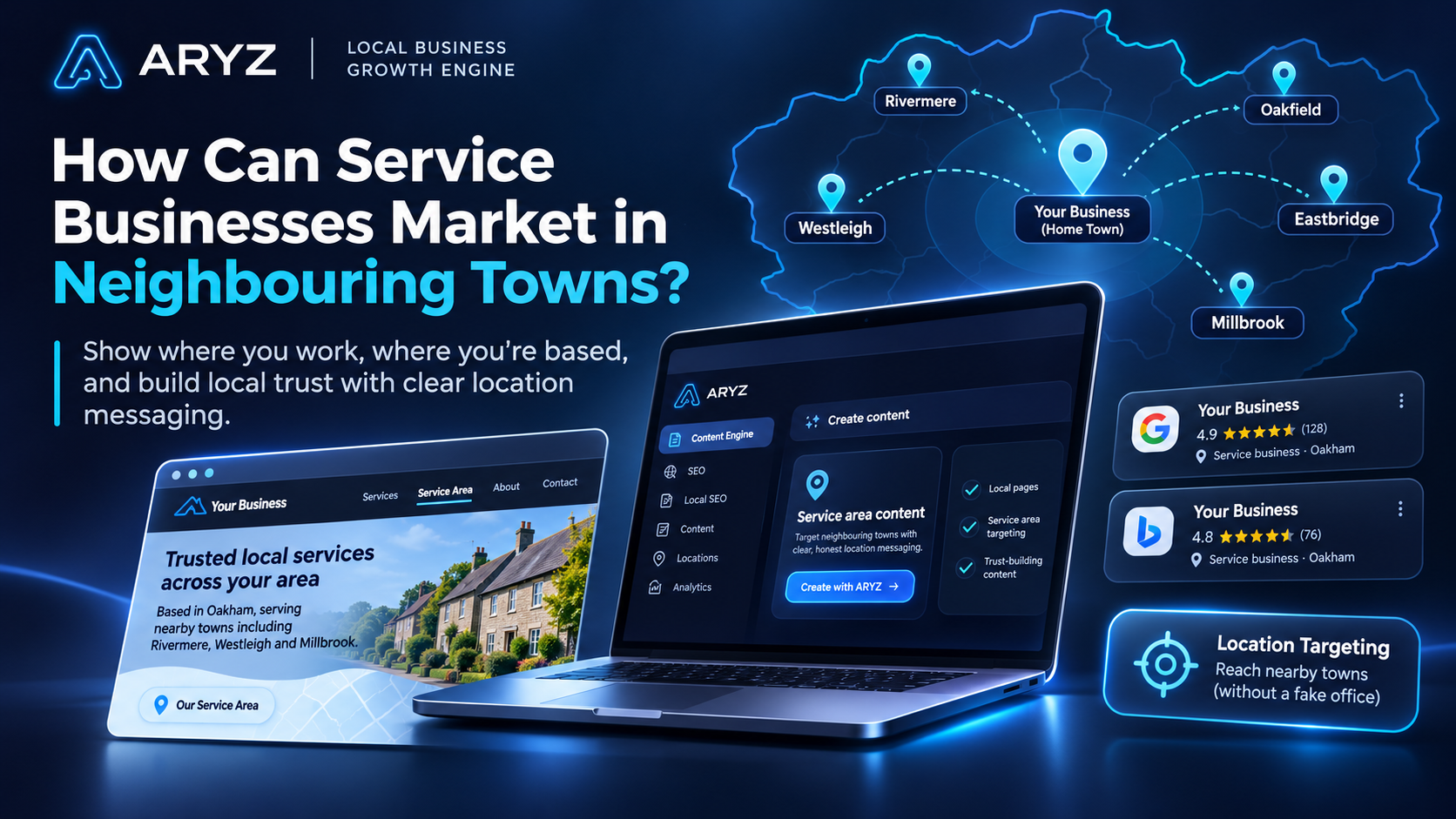
How can you market your services in neighbouring towns without implying you have an office there?
A one-town marketing test for UK service businesses: clearer location claims, useful pages and genuine local evidence.
Describe where you provide services, distinguish that from where your business is based, and support local messaging with genuine evidence. For example: “Based in [base town], we visit customers in [neighbouring town] for [service].” To market services in neighbouring towns, start with one priority town and make the whole customer journey accurate—from the advert or listing to your website and enquiry form.
Start with a location-claims audit
Before creating more content, check what a prospective customer could reasonably understand from your existing marketing.
Read your website, listings, social profiles and adverts together. Does one say “serving [town]” while another describes “[town] office”? Check headings, footers, contact details and enquiry confirmations—not just the main copy.
Check the location claim, not just the town name
- Identify your actual base and whether customers can visit it.
- Separate visiting customers, remote delivery and customer visits to your premises.
- Flag “branch”, “office”, “showroom” or “based in” wherever the description is inaccurate.
- Check that photographs and map labels do not suggest premises you do not have.
- Assign each correction to someone who can update it.
Use this practical test: if someone arrived expecting to walk into your premises in that town, would your marketing explain why they should not? If not, clarify the service arrangement.
Choose one town for your first test
Make the first experiment manageable: one service, one neighbouring town and one clear customer need.
For a visiting service business, assess travel, appointment availability and the types of work you can realistically accept. For remote professional services, consider whether customers need an in-person meeting and how you would arrange it.
- Service fit: can you deliver the advertised service there?
- Capacity: can you accommodate enquiries alongside existing commitments?
- Useful detail: can you explain something customers need to know before booking?
- Evidence: do you have relevant work, feedback or relationships you can accurately describe?
You can introduce your service to a town where you have not yet worked. Be straightforward: describe your availability and relevant experience without presenting it as an established local track record.
Write a clear service-area promise
Tell customers what you do, where you deliver it and how they receive the service.
| Service arrangement | Suggested wording |
|---|---|
| You visit customers | Based in [base town], we provide [service] at customers’ properties in [neighbouring town]. |
| You work remotely | We provide [service] remotely for businesses in [town]. Our team is based in [base town]. |
| Customers visit your premises | Customers from [town] can visit our [base town] premises by [actual appointment arrangement]. |
| You serve selected areas | We cover [areas] for [service]. Send your postcode so we can confirm availability. |
Adapt these examples only where they match your actual arrangements.
A heading such as “[Service] for customers in [town]” identifies the audience without claiming an office. Follow it with practical delivery information. Avoid vague reassurance such as “always nearby” if it obscures where you operate from or how appointments work.
Give the town a useful website destination
Choose the page format around customer questions, not a list of place names.
Use one service-area page when the service and booking arrangements are substantially the same across nearby towns. Consider town-specific service pages when you have enough relevant information to make each page useful in its own right.
A useful town page can explain which services are available, how visits are arranged, coverage boundaries and genuine examples of relevant work. Do not manufacture local knowledge or add unrelated landmarks simply to make the page look local.
- Page title: “[Service] in [town] | [Business name]”.
- Heading: “[Service] at your property in [town]”.
- Opening: state your actual base and explain your visiting service.
- Call to action: “Tell us your postcode and what you need”.
Link the page from your main service or coverage page so customers can find it. Treat this local SEO work as an exercise in usefulness and accuracy, not a promise of rankings.
Connect listings, adverts and local evidence
Carry the same service arrangement into every place a customer might discover you.
In business listings, distinguish address information from service-area information wherever those fields are available. Check each directory’s current guidance rather than assuming every listing works alike. Do not enter a neighbouring-town address simply to appear present there.
Use the same distinction in Facebook and Instagram profiles and posts. Support it with genuine project photographs or customer feedback shared with permission. Explain what the evidence demonstrates; do not imply that work completed elsewhere happened in the target town.
Build relationships with complementary businesses, relevant community groups and local organisers. Offer something useful—a practical contribution, introduction or relevant service information. Describe partnerships only when they genuinely exist, and agree any public references with those involved.
Measure enquiries and improve one town
Evaluate whether the messaging attracts work you can actually deliver.
Record the requested service area, service needed, enquiry source and whether the job fits your coverage and capacity. Note questions about your location: repeated confusion is a reason to revise the wording, even if the page attracts attention.
ARYS supports Business DNA containing your services, audiences, locations, tone and approved claims. Use it to guide AI-assisted drafts, then review each location reference before publication. Early-access features and integrations remain subject to current availability.
For the next measurement step, read Which marketing numbers help you decide where to spend your next £500? For planning around changing demand, see When should a seasonal business start marketing to fill its quieter months?
Start now: review location claims across your website, listings and adverts, then improve one priority town’s messaging. Expand only when you can keep the information useful, accurate and manageable.
ARYS field guide: one town, one clear offer
A focused service-area marketing test
Make your next town’s message clearer
Audit your location claims, then improve one town’s page or service description. Create your ARYS account to build Business DNA that can guide your marketing drafts.
Frequently asked questions
Written by
ARYS
Editorial team