What Happens If You Skip Comments and Customer Engagement?
Learn what agencies risk by ignoring comments and customer engagement, and how ARYS helps organise replies, leads and client workflows.
ARYS · · 9 min read
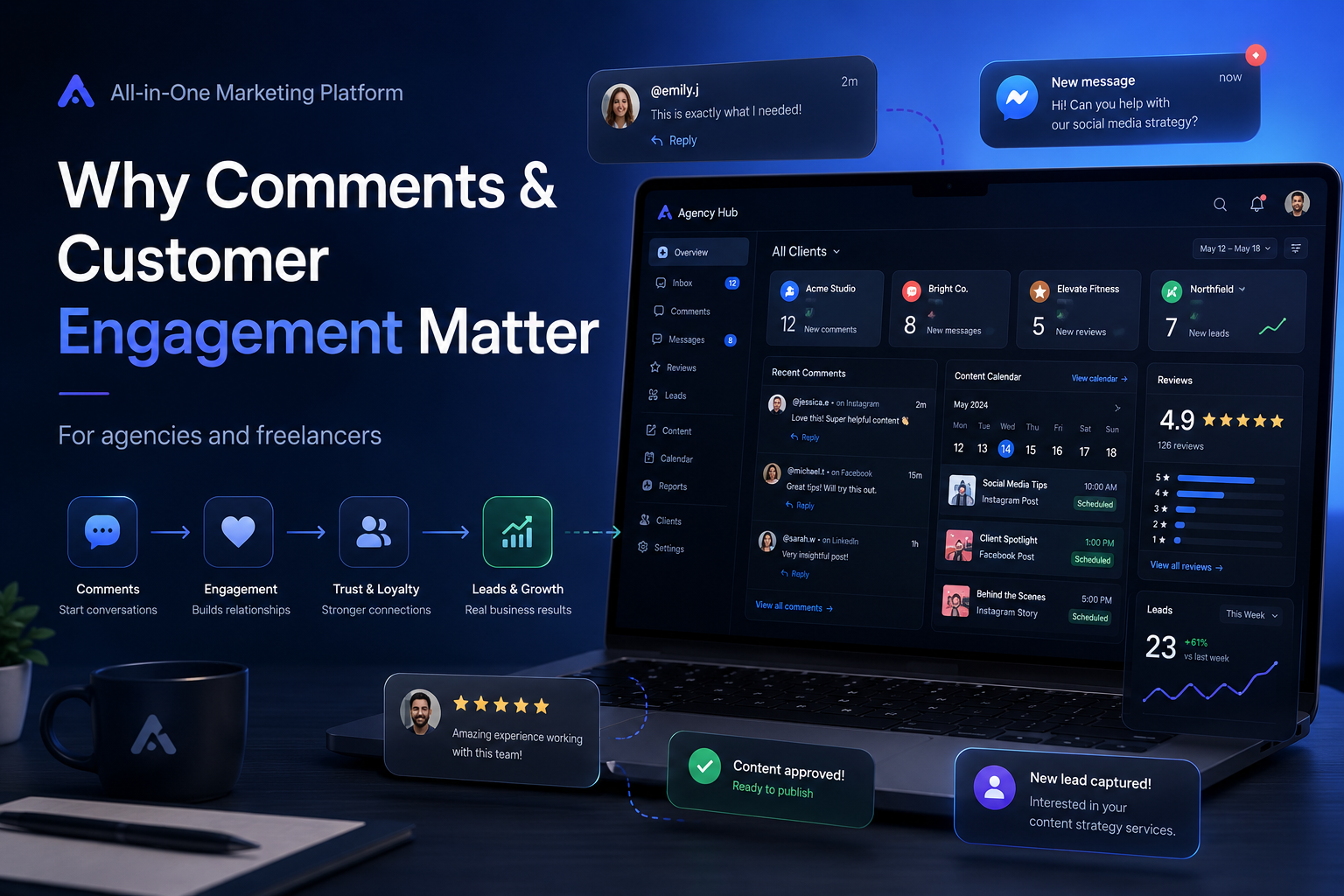
What Happens If You Skip Comments and Customer Engagement?
A practical guide for agencies and freelancers managing client visibility, reputation and enquiries.
If you skip comments and customer engagement, you leave public questions unanswered, weaken trust, miss useful buying signals and make it harder to prove the value of your marketing work. For agencies and freelancers, the issue is not just a few ignored replies; it is the slow build-up of missed conversations, unclear ownership and disconnected customer activity across every client account you manage.
Why comments and engagement get missed
Most engagement problems do not start with laziness. They usually start with scattered tools, unclear responsibility and too many client accounts competing for attention.
For marketing agencies and freelance marketers, comments and customer engagement often sit in an awkward gap between content creation, community management, customer service and sales. A client may expect replies to happen, but nobody has clearly agreed who owns them, what should be answered publicly, what needs approval and what should be passed to the sales team.
That gap becomes bigger when each client has a different mix of channels, locations, tone of voice and internal contacts. One client wants a friendly, informal tone. Another needs every response approved. A third has several locations and different service teams. Without a clear system, it is easy for comments, questions and mentions to be seen late or missed completely.
There is also a practical problem: content is usually planned, but engagement is reactive. A post can be scheduled in advance. A customer question cannot. If your agency workflow is built around publishing only, the conversation that follows the post can become an afterthought.
What can happen when engagement is ignored
Skipping engagement does not usually cause one dramatic problem overnight. It creates a chain of smaller issues that slowly reduce trust, clarity and opportunity.
The most obvious consequence is that public questions go unanswered. If someone asks about availability, pricing approach, service areas, opening hours or how to book, silence can make the business look unresponsive. Even when the client is excellent offline, the online impression can tell a different story.
Ignored comments can also reduce the value of the content you are already creating. A useful post may attract questions, objections or local interest, but if nobody follows up, the post becomes a broadcast rather than a conversation. That means you may be doing the hard work of attracting attention without taking the next practical step.
There is a reputation issue too. People often look at how a business responds before they decide whether to enquire. Polite, helpful engagement shows that the business is active and listening. Repeated silence, defensive replies or inconsistent tone can create doubt.
For agencies, missed engagement also weakens reporting. If comments, review replies, enquiries and follow-up actions are not organised, it becomes harder to explain what happened after content went live. You may know the campaign created conversation, but you may not have a clean way to show which conversations needed action or which turned into leads.
| What gets missed | Likely impact | What to put in place |
|---|---|---|
| Customer questions | Potential enquiries may not move forward | A clear reply and escalation process |
| Service objections | Useful insight is lost before it reaches the client | A way to tag recurring questions and objections |
| Positive comments | Opportunities to build loyalty and visibility are underused | Simple acknowledgement and relationship-building replies |
| Complaints or concerns | Small issues can become more visible if left unanswered | Approved response guidelines and escalation rules |
| Lead signals | Sales teams may not receive useful context | Lead capture and follow-up tracking |
Common consequences of poor engagement management
Why this matters more for agencies and freelancers
A single business can sometimes manage engagement informally. Agencies and freelancers need a repeatable process because the volume, context and risk are higher.
If you manage several clients, the problem is not just replying to one comment. It is remembering each client’s tone, services, locations, approval rules and commercial priorities. A reply that works perfectly for one client may sound wrong for another. That is where ad hoc engagement becomes risky.
Agencies also need to protect their time. Without structure, engagement work can become constant channel-checking, screenshot-sharing and message chasing. That can eat into the time set aside for strategy, content and reporting. Worse, it can make engagement feel like unpaid extra work rather than a defined part of the service.
There is also a client-confidence issue. Clients do not only judge you on what you publish; they judge you on whether marketing activity feels joined up. If a post receives questions and nobody knows who replied, what was said or whether the person became a lead, the client may see the marketing as disconnected.
- You need separate workspaces so each client keeps its own brand voice, services and approved claims.
- You need a simple way to review AI-assisted replies before anything important is published or sent.
- You need visibility across content, reviews, customer engagement and leads, not separate fragments in different tools.
- You need a workflow that works for small clients now and can scale as you add more accounts.
This is why engagement should be treated as part of the marketing operation, not a side task. It connects brand voice, customer service, sales follow-up and reporting.
A simple engagement workflow for client accounts
You do not need a complicated process to improve engagement. You need clear rules that help your team act consistently and know when to involve the client.
- **Define ownership** — Agree who checks engagement, who drafts replies, who approves sensitive responses and who handles sales or service follow-up.
- **Set response categories** — Separate comments into simple groups such as general praise, service questions, complaints, sales interest, spam and internal escalation.
- **Create client-specific guidance** — Record tone of voice, approved claims, services, locations, phrases to avoid and any topics that need approval before replying.
- **Connect engagement to leads** — If a comment or message suggests buying intent, record it as a lead or follow-up task rather than leaving it buried in the channel.
- **Review patterns regularly** — Look for repeated questions, objections and content opportunities. Good engagement data can shape better posts, FAQs and campaigns.
The aim is not to turn every comment into a long process. Simple replies should stay simple. The point is to stop important customer signals from being missed and to make sure more sensitive responses are handled with care.
Client engagement checklist
- Do we know who is responsible for monitoring comments and engagement?
- Do we have the client’s preferred tone and approved wording recorded?
- Do we know which topics need approval before reply?
- Can we capture a lead signal when a customer shows intent?
- Can we report on engagement activity without digging through multiple tools?
How ARYS supports comments and customer engagement
ARYS is designed to help agencies and freelancers bring engagement into the same workspace as content, reviews, leads and reporting.
ARYS is an AI-powered marketing platform built to help businesses plan, create, organise and manage marketing activity from one central workspace. For agencies and freelancers, that matters because customer engagement rarely sits neatly in one place. It is connected to content, reviews, campaigns, brand voice and follow-up activity.
With ARYS, each business or client can have its own Business DNA. That includes information such as services, audiences, goals, tone and approved claims. This helps produce more relevant AI-assisted suggestions for captions, replies, review responses and marketing ideas, while keeping the user in control through review, editing and approval workflows.
ARYS also supports multi-business workspaces, so agencies can manage separate clients, brands or locations without mixing their content and context. That separation is especially useful when engagement needs to reflect different voices, offers, locations or approval requirements.
The platform is still developing, so ARYS is careful to distinguish between live, beta and planned features. Where comments, customer engagement, connected platforms or publishing workflows depend on available integrations, users should check what is currently supported inside the platform. The principle stays the same: bring the work into one organised place so it is easier to review, approve, track and act on.
If review management is also part of your client service, you may find our related article useful: How Often Is AI Review Management Required?. Reviews and comments are different channels, but both influence how responsive and trustworthy a business appears online.
What to do next if engagement has slipped
If comments and customer engagement have been inconsistent, start by getting control of the workflow before trying to reply to everything at once.
First, audit the main client accounts you manage. Look for unanswered customer questions, repeated objections, common praise, complaints that need care and comments that suggest buying intent. Do not just count comments; look at what they reveal.
Next, agree the rules with each client. Decide what your agency can answer directly, what needs client approval and what should be passed to sales or customer service. This prevents slow replies without putting your team in a position where they have to guess.
Then, create a simple rhythm. That may include scheduled checks, a shared approval queue, lead tagging and a regular review of engagement themes. The best process is the one your team and client will actually use.
Finally, bring engagement into your wider reporting. Show clients what people are asking, which content started conversations and what actions were taken. That makes engagement visible as a valuable part of the marketing service, not an invisible task happening in the background.
The customer engagement chain
What agencies need to keep connected
Bring client engagement into one organised workspace
Create your ARYS account to build your Business DNA, organise marketing activity and explore how AI-assisted workflows can simplify comments, reviews, leads and content management.
Frequently asked questions
Written by
ARYS
Editorial team